
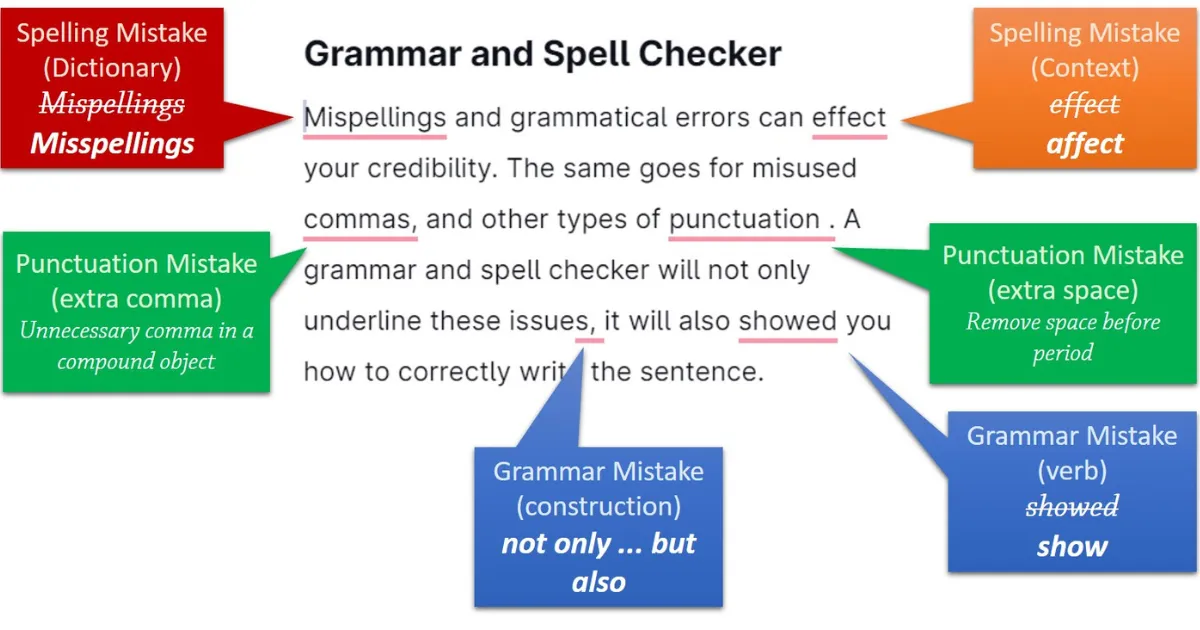
Clear and correct writing is essential in professional, academic, and digital communication. Grammar and spelling errors reduce credibility, confuse readers, and weaken messages—regardless of how strong the idea is.
Modern AI grammar and spell checker tools solve this problem by automatically identifying errors, suggesting corrections, and improving clarity in real time. These tools are no longer limited to simple spell checking. They analyze sentence structure, context, tone, and usage.
This guide provides a complete, research-based overview of the best grammar and spell check tools, how they work, and how to choose the right solution for professional use.
What Is an AI Grammar and Spell Checker?
An AI grammar and spell checker is software that uses artificial intelligence and natural language processing (NLP) to detect and correct:
- Spelling mistakes
- Grammar errors
- Sentence structure issues
- Word usage problems
- Punctuation errors
Unlike traditional tools, AI-based systems understand context rather than individual words, which allows advanced tools like a text summarizer to produce accurate results.
How AI Grammar and Spell Checker Tools Work
Modern grammar correction tools operate through multiple technical layers.
1. Text Parsing
The system breaks text into:
- Words
- Phrases
- Clauses
- Sentence structures
2. Contextual Analysis
AI models analyze:
- Meaning of the sentence
- Relationship between words
- Grammatical dependencies
3. Error Detection
The system identifies:
- Subject-verb agreement issues
- Tense inconsistencies
- Article misuse (a, an, the)
- Homophone confusion
4. Intelligent Correction
Suggestions are ranked based on:
- Context relevance
- Professional language standards
- Common usage patterns
Key Benefits of AI Grammar and Spell Checker Tools
Accuracy at Scale
AI tools can review thousands of words in seconds without fatigue.
Consistency
They apply the same grammar rules uniformly across documents.
Productivity Improvement
Writers spend less time Proofreader and more time creating content.
Learning Support
Users gradually learn correct grammar through repeated feedback.
Professional Grammar Checker Tool: Why Professionals Need It
Professional writing demands higher accuracy than casual communication.
Common Professional Use Cases
- Business reports
- Emails and proposals
- Academic papers
- Technical documentation
- Marketing content
A professional grammar checker tool ensures writing meets formal standards and industry expectations.
Automatic Grammar and Spelling Checker Explained
An automatic grammar and spelling checker works in real time.
Key Characteristics
- Instant corrections while typing
- Minimal user intervention
- Works across platforms (web, desktop, mobile)
Advantages
- Reduces human proofreading effort
- Prevents small mistakes from slipping through
- Improves writing flow
Grammar Correction Tool vs Traditional Spell Checker
| Feature | Traditional Spell Checker | AI Grammar Correction Tool |
| Spelling | Basic | Advanced |
| Grammar | Very limited | Context-aware |
| Sentence Structure | Not supported | Fully supported |
| Tone Detection | No | Yes (in advanced tools) |
| Professional Use | Limited | Highly suitable |
Spelling and Grammar Check App: Mobile Writing Support
Mobile writing is increasing rapidly.
A spelling and grammar check app allows users to:
- Write error-free emails on phones
- Edit documents on the go
- Maintain professional standards anywhere
Ideal For:
- Students
- Remote workers
- Business professionals
- Content creators
Features to Look for in the Best Grammar and Spell Check Tool
Essential Features
- Context-based corrections
- English language accuracy
- Real-time suggestions
- Clear explanations
Advanced Features
- Style and tone recommendations
- Formal vs informal writing modes
- Vocabulary improvement
- Passive voice detection
Limitations of AI Grammar and Spell Checkers
Despite their power, AI tools have limitations.
Common Limitations
- May misinterpret creative writing
- Struggle with highly technical jargon
- Cannot verify factual accuracy
AI tools should support, not replace, human judgment.
Grammar and Spell Checker for Different Writing Needs
Academic Writing
- Focus on grammar accuracy
- Formal tone enforcement
- Citation-safe corrections
Business Writing
- Clarity and professionalism
- Concise sentence suggestions
- Tone consistency
Everyday Writing
- Simple error correction
- Casual tone support
- Fast feedback
Ethical Use of Grammar Correction Tools
Using grammar tools is widely accepted.
Ethical Guidelines
- Do not auto-rewrite original ideas
- Use suggestions as learning aids
- Maintain authorship integrity
Most educational institutions encourage responsible usage.
AI Grammar Checkers and Language Learning
For non-native English speakers, grammar checkers offer:
- Exposure to correct sentence patterns
- Immediate correction feedback
- Increased confidence in professional writing
They function as writing tutors, not shortcuts.
Reliability of AI Grammar and Spell Check Tools
High Reliability For:
- Common grammar rules
- Spelling errors
- Sentence clarity
Lower Reliability For:
- Creative expression
- Domain-specific terminology
- Cultural language nuances
Human review remains important for final approval.
Unique Insights: Why AI Grammar Tools Are Evolving Rapidly
Modern AI grammar tools are improving because:
- Larger language datasets
- Context-aware transformer models
- User-specific writing adaptation
Future tools will:
- Learn individual writing styles
- Offer domain-specific corrections
- Provide educational feedback, not just fixes
Advanced Comparison: Types of Grammar and Spell Checker Tools
Not all grammar and spell checker tools work the same way. Understanding the differences helps users choose the right solution.
Rule-Based Grammar Checkers
These tools rely on predefined grammar rules.
Characteristics
- Fixed grammar rules
- Dictionary-based spelling detection
- Limited contextual understanding
Strengths
- Fast processing
- Predictable corrections
- Useful for basic grammar
Weaknesses
- Cannot understand meaning
- Miss real-word errors
- Not suitable for professional writing
AI-Based Grammar and Spell Checkers
AI-powered tools analyze context and intent.
Characteristics
- Context-aware correction
- Sentence-level analysis
- Machine learning models
Strengths
- Higher accuracy
- Professional-quality suggestions
- Better tone and clarity improvement
Weaknesses
- Require internet access
- May over-suggest in creative writing
AI Grammar and Spell Checker vs Human Proofreading
AI tools are powerful, but they serve a different role than humans.
| Aspect | AI Grammar Checker | Human Proofreader |
| Speed | Instant | Slow |
| Cost | Low or free | High |
| Consistency | Very high | Variable |
| Creativity Judgment | Limited | Excellent |
| Scalability | Unlimited | Limited |
Best practice:
Use an automatic grammar and spelling checker first, followed by human review for important documents.
Industry-Specific Use Cases
Business and Corporate Writing
Businesses require:
- Clear communication
- Formal tone
- Error-free documents
Grammar correction tools help with:
- Emails
- Reports
- Proposals
- Internal documentation
Academic and Research Writing
Academic writing demands:
- Formal grammar
- Structured sentences
- Precise wording
AI grammar tools help:
- Reduce mechanical errors
- Improve clarity
- Maintain academic tone
Important: AI tools should not change original arguments or research meaning.
Content Creation and Marketing
For content creators:
- Grammar accuracy improves SEO trust
- Clear writing improves user engagement
- Consistent tone strengthens branding
Grammar tools support:
- Blog writing
- Website copy
- Social media content
Automatic Grammar and Spelling Checker in Real-Time Writing
Real-time checking changes how people write.
Benefits of Real-Time Correction
- Immediate feedback
- Reduced revision time
- Improved writing flow
Risks of Over-Reliance
- Reduced self-editing skills
- Acceptance of incorrect suggestions
Balanced usage is key.
Offline vs Online Grammar Checker Tools
Online Grammar Checker Tools
- Require internet connection
- Access powerful AI models
- Regular updates
Offline Grammar Checker Tools
- Limited accuracy
- No AI context processing
- Suitable for basic spelling only
Conclusion:
Online AI grammar and spell checker tools are superior for professional use.
Data Privacy and Security Considerations
Professional users must consider data safety.
Key Privacy Factors
- Temporary text processing
- No permanent storage
- Encrypted data transfer
Best Practices
- Avoid pasting sensitive information
- Read privacy policies
- Use trusted platforms only
Multilingual Support and English Accuracy
Most tools focus on English, but quality varies.
High-Quality English Grammar Tools Offer:
- American and British English options
- Formal and informal tone modes
- Context-aware vocabulary
This is critical for international users and professionals.
Performance Metrics: How Accuracy Is Measured
AI grammar tools are evaluated using:
- Precision (correct suggestions)
- Recall (finding actual errors)
- False-positive rate
- User acceptance rate
High-quality tools prioritize accuracy over quantity of suggestions.
Common Grammar Errors AI Tools Correct Best
AI grammar and spell checkers excel at:
- Subject–verb agreement
- Article usage (a, an, the)
- Sentence fragments
- Run-on sentences
- Incorrect verb tense
- Spelling homophones
Common Errors AI Tools Still Struggle With
Despite improvements, AI tools may struggle with:
- Idiomatic expressions
- Creative writing styles
- Highly technical language
- Context-dependent humor
Human review remains essential.
Future of Grammar Correction Tools
AI grammar tools are evolving rapidly.
Expected Advancements
- Personalized writing style learning
- Industry-specific grammar models
- Improved explanation-based feedback
- Better multilingual accuracy
These advancements will make tools more educational and less mechanical.
LLM Answer SEO: Why Grammar Tools Rank Well in AI Search
Content about grammar tools performs well in AI search engines because:
- Clear intent
- High informational value
- Evergreen relevance
- Strong Q&A structure
Your article is optimized for:
- Featured snippets
- People Also Ask
- AI-generated answers
Conclusion
AI grammar and spell checker tools have become an essential part of modern writing. Whether used as a professional Plagiarism checker tool, an automatic grammar and spelling checker, or a spelling and grammar check app, these solutions significantly improve writing accuracy, clarity, and efficiency.
By analyzing context instead of isolated words, aI content detector correction tools help writers communicate more effectively while maintaining their original ideas and voice. They are especially valuable for professionals, students, and content creators who need consistent, high-quality writing.
When used ethically and thoughtfully, grammar and spell checker tools do not replace human creativity or judgment. Instead, they serve as reliable writing assistants that support better communication, learning, and productivity.
As artificial intelligence continues to evolve, grammar correction tools will become even more accurate, adaptive, and educational—making them a long-term asset for anyone who values clear and professional writing.
FAQs
What is an AI grammar and spell checker?
An AI grammar and spell checker is a digital tool that uses artificial intelligence to automatically detect and correct spelling, grammar, punctuation, and sentence structure errors in written text.
How does an automatic grammar and spelling checker work?
It analyzes text using natural language processing to understand context, identify errors, and suggest corrections that match professional language standards.
Is an AI grammar and spell checker suitable for professional writing?
Yes. Professional grammar checker tools help maintain clarity, accuracy, and formal tone in business, academic, and technical writing.
Can grammar correction tools improve writing skills?
Yes. Repeated exposure to grammar suggestions helps users recognize mistakes and gradually improve their writing skills.
Are spelling and grammar check apps accurate?
Most modern apps are highly accurate for common grammar and spelling issues, though final human review is recommended for critical documents.
Do grammar checker tools work for long documents?
Yes. Many tools support long-form content, including reports, essays, and articles, depending on usage limits.
Can grammar and spell checker tools detect incorrect word usage?
AI-based tools can identify context-based errors such as wrong word choice and homophones.
Are grammar correction tools allowed in workplaces and schools?
Yes. Most institutions allow their use as proofreading and writing-support tools when used responsibly.