
In 2026, a fast and reliable internet connection is essential for streaming videos, online gaming, video conferencing, remote work, and managing smart devices. Bandwidth is the maximum amount of data your internet connection can handle at any moment, usually measured in Mbps (Megabits per second). Low bandwidth leads to buffering, slow downloads, laggy games, and interrupted video calls.
A Bandwidth Calculator helps estimate how much internet capacity you need based on the number of devices, type of online activity, and usage duration. Whether you are a home user, gamer, or business network administrator, a bandwidth calculator ensures smooth performance, prevents congestion, and helps select the right internet plan.
By understanding your bandwidth requirements, you can optimize your network, avoid slow connections, and make informed decisions to improve your online experience.
What is Bandwidth?
Bandwidth refers to the maximum amount of data that can be transmitted over an internet connection in a given amount of time, usually measured in Mbps (Megabits per second).
Think of it like a highway: the wider the highway (higher bandwidth), the more cars (data) can travel at the same time. Low bandwidth can cause slow loading times, buffering, and poor performance in online proofreader applications.
Why it matters:
- Streaming HD videos requires higher bandwidth
- Gaming and live streaming need low latency and fast speeds
- Businesses require sufficient bandwidth for multiple users
Why You Need a Bandwidth Calculator
Knowing your bandwidth needs is no longer optional. Here’s why:
- Avoid Network Slowdowns: Overloading your network can cause buffering and delays.
- Plan for Streaming & Gaming: Streaming services and online games consume high bandwidth.
- Manage Multiple Devices: Smart homes and offices often have several devices connected simultaneously.
- Control Data Usage: Avoid exceeding data caps and unnecessary charges.
- Optimize Business Networks: Ensure employees have sufficient bandwidth for productivity apps and cloud services.
How Does a Bandwidth Calculator Work?
A Bandwidth Calculator estimates your data usage based on:
- Number of users or devices
- Type of activity (streaming, browsing, gaming)
- Duration of internet usage
- File size or data transfer
Example:
Streaming 4K video for 1 hour consumes ~7 GB. A bandwidth calculator helps determine if your connection can handle multiple devices streaming simultaneously.
Benefits of Using a Bandwidth Calculator:
- Avoid exceeding your data limits
- Prevent network slowdowns
- Plan server and network capacity for businesses
- Save money by choosing the right internet speed test plan
Types of Bandwidth Calculators

Different calculators serve different purposes. Understanding these can help you pick the right one.
1. Internet Bandwidth Calculator
- Focused on household or office networks.
- Measures typical web browsing, streaming, and downloads.
- Useful for selecting internet plans.
2. Network Bandwidth Calculator
- Designed for IT professionals and business networks.
- Calculates bandwidth for servers, routers, and multiple users.
- Helps prevent network congestion.
3. Streaming Bandwidth Calculator
- Estimates bandwidth for platforms like Netflix, YouTube, and Twitch.
- Differentiates between HD, Full HD, 4K, and 8K streaming.
4. Gaming Bandwidth Calculator
- Calculates bandwidth for online multiplayer games.
- Considers download, upload, latency, and packet loss.
Bandwidth vs Internet Speed (Important Difference)
| Feature | Bandwidth | Internet Speed |
| Meaning | Data capacity | Data transfer rate |
| Unit | Mbps/Gbps | Mbps |
| Role | Maximum limit | Actual performance |
Many people confuse these terms, but they are different.
How to Calculate Bandwidth Usage
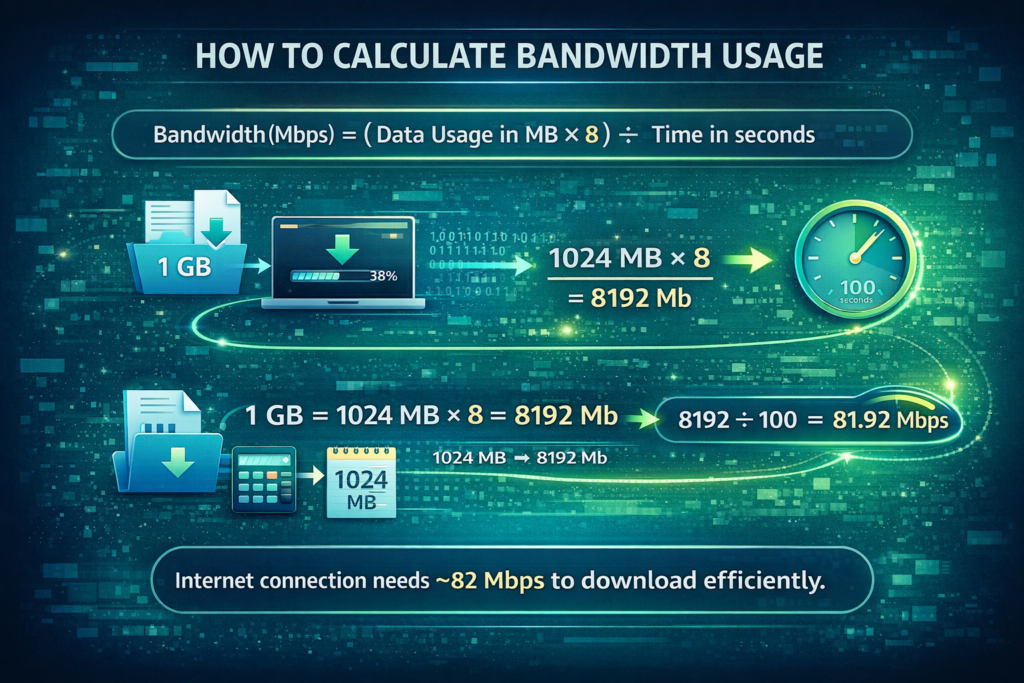
You can calculate bandwidth manually using the formula:
Bandwidth (Mbps) = (Data Usage in MB × 8) ÷ Time in seconds
Step-by-step Example:
- You download a 1 GB file
- Time taken = 100 seconds
- Convert 1 GB → 1024 MB × 8 = 8192 Mb
- Divide by 100 seconds → 8192 ÷ 100 = 81.92 Mbps
This tells you your internet connection needs to support ~82 Mbps to download the file efficiently.
Using a Bandwidth Calculator online automates this calculation instantly.
Bandwidth Requirements for Streaming & Gaming
Different activities require different bandwidth:
| Activity | Recommended Bandwidth |
| Standard Definition Video | 3–4 Mbps |
| HD Video Streaming | 5–8 Mbps |
| 4K Ultra HD Video | 15–25 Mbps |
| Online Gaming | 3–6 Mbps |
| Video Conferencing | 2–6 Mbps |
| Large File Downloads | Depends on file size |
Tip: Always add 20–30% extra bandwidth if multiple devices are connected.
Factors Affecting Bandwidth Usage
To get accurate results from any bandwidth calculator, consider these factors:
- Video Quality: Higher resolutions consume more bandwidth.
- 480p: 0.7 Mbps
- 720p HD: 3 Mbps
- 1080p Full HD: 5 Mbps
- 4K UHD: 15–25 Mbps
- Number of Devices: More devices increase cumulative usage.
- Applications: Cloud storage, VPN, video calls, and online backups require significant bandwidth.
- Connection Type: Fiber offers more consistent speeds than DSL or cable.
- Peak Hours: Heavy internet usage during peak times can slow down networks.
How to Use an Online Bandwidth Calculator Tool
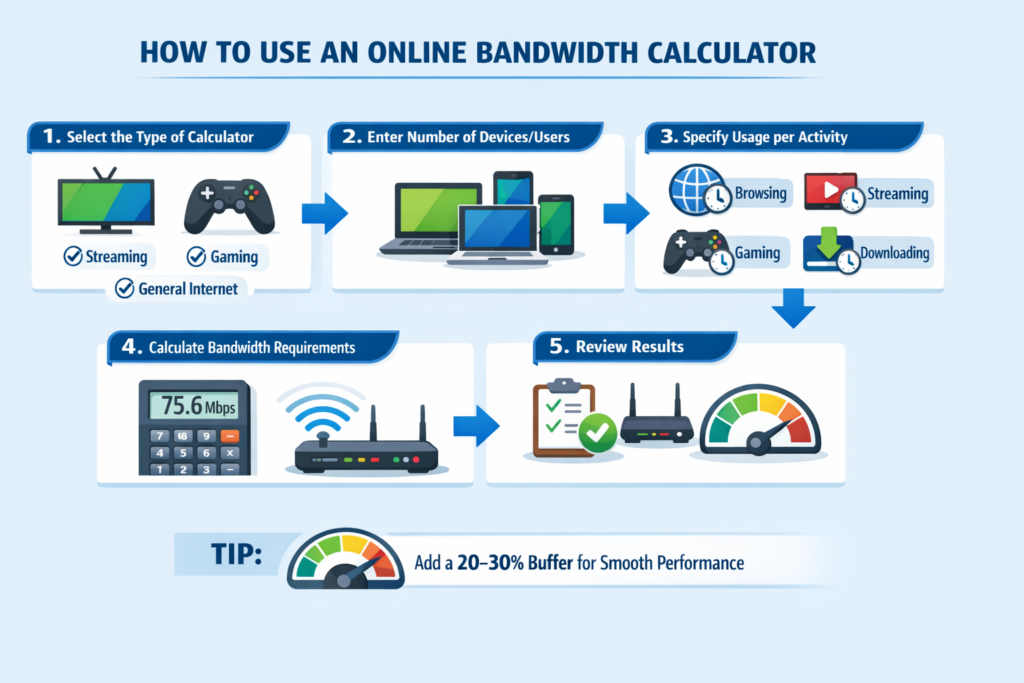
Using an online bandwidth calculator is straightforward. Follow these steps:
- Select the type of calculator: Choose streaming, gaming, or general internet usage.
- Enter the number of devices/users: Include all devices connected simultaneously.
- Specify usage per activity: Include hours of browsing, streaming, gaming, or downloading.
- Calculate bandwidth requirements: The tool provides an estimated Mbps requirement.
- Review results: Adjust your internet plan or network setup if needed.
Tip: Always add a buffer of 20–30% to accommodate unexpected traffic spikes.
Practical Examples of Bandwidth Calculations
Example 1: Home Streaming
- 2 users streaming HD videos at 5 Mbps each
- 1 user gaming at 10 Mbps
- 3 smartphones browsing social media at 1 Mbps each
Calculation:
(2×5)+10+(3×1)=24 Mbps minimum requirement(2×5) + 10 + (3×1) = 24 \text{ Mbps minimum requirement}(2×5)+10+(3×1)=24 Mbps minimum requirement
Example 2: Small Office Network
- 10 employees video conferencing (5 Mbps each)
- 10 browsing emails (1 Mbps each)
- File downloads 20 Mbps
Calculation:
(10×5)+(10×1)+20=80 Mbps minimum requirement(10×5) + (10×1) + 20 = 80 \text{ Mbps minimum requirement}(10×5)+(10×1)+20=80 Mbps minimum requirement
Bandwidth Usage Examples
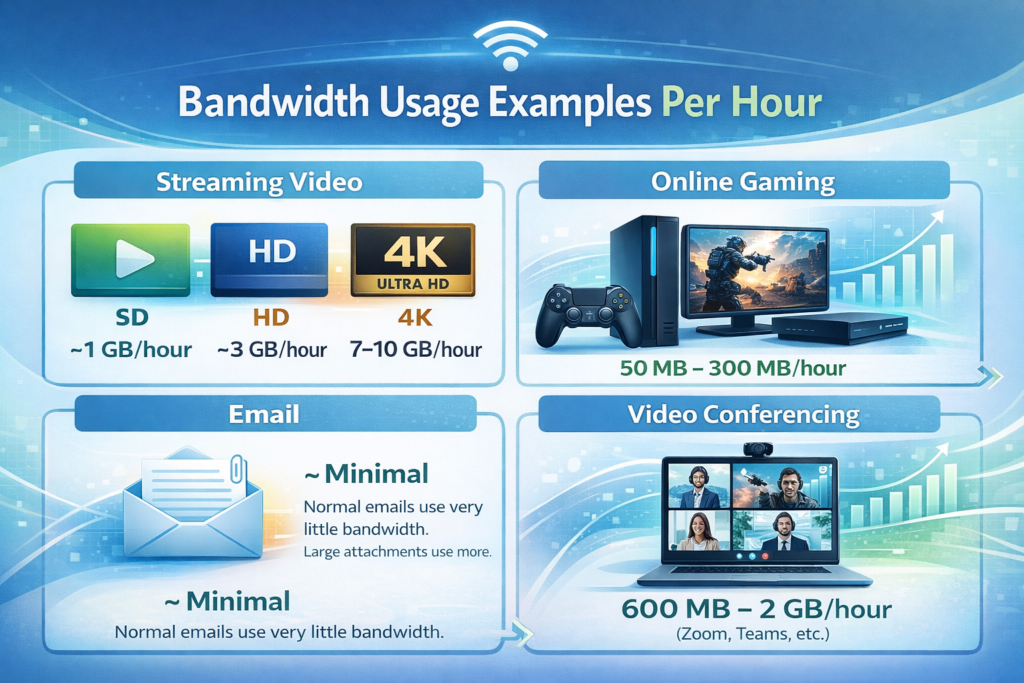
Understanding how much bandwidth different activities consume can help you plan your internet connection and avoid slowdowns. Here are common examples of bandwidth usage per hour:
Streaming Video
- Standard Definition (SD): ~1 GB per hour
- High Definition (HD): ~3 GB per hour
- 4K Ultra HD: 7–10 GB per hour
Online Gaming
- Gaming: 50 MB – 300 MB per hour (depending on the game and online activity)
- Email usage: Very low (mostly negligible unless sending large attachments)
Video Conferencing
- Zoom / Video Calls: 600 MB – 2 GB per hour (varies by video quality)
Quick Reference Table
| Activity | Bandwidth Usage (Per Hour) |
| SD Video Streaming | 1 GB |
| HD Video Streaming | 3 GB |
| 4K Video Streaming | 7–10 GB |
| Online Gaming | 50–300 MB |
| Very low | |
| Zoom / Video Calls | 600 MB – 2 GB |
Tip: For multiple whitespace remover devices streaming or gaming simultaneously, always add 20–30% extra bandwidth to your estimate to ensure smooth performance.
How Much Bandwidth Do You Need?
The exact bandwidth you need depends on your internet habits:
- Single user browsing: 5–10 Mbps
- Family with multiple devices: 25–50 Mbps
- Small business network: 50–100 Mbps
- Large enterprise: 100+ Mbps
Use a bandwidth calculator to account for all users and devices simultaneously.
Tips to Reduce Bandwidth Usage
- Compress png images and videos before uploading
- Limit background applications
- Use ad blockers
- Schedule large downloads during off-peak hours
- Monitor bandwidth usage with online tools
How to Calculate Bandwidth for Your Website
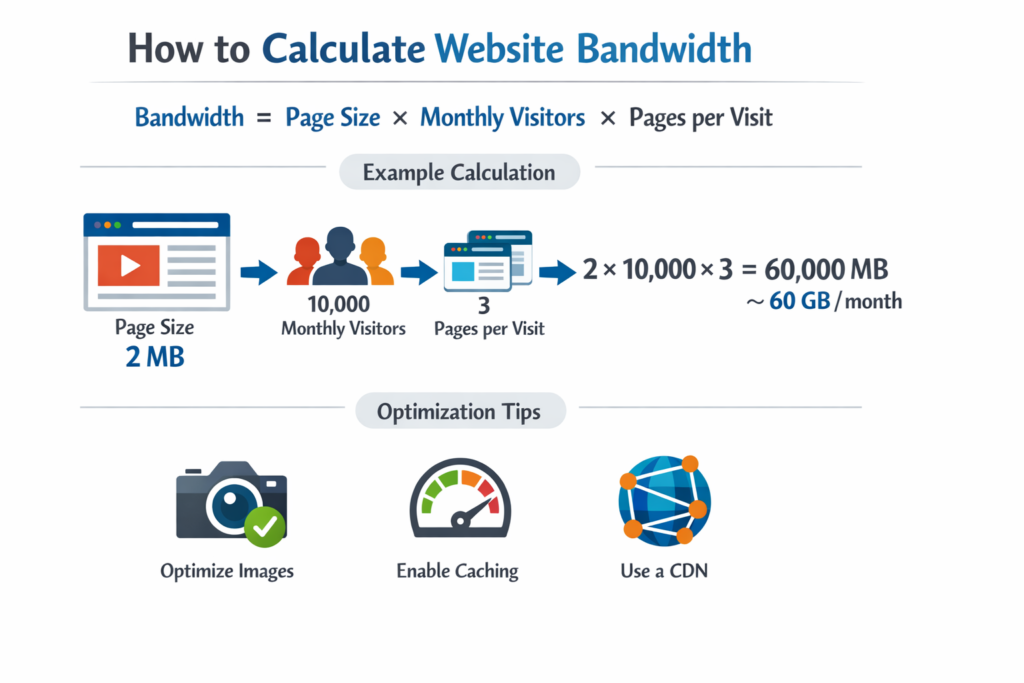
To calculate website bandwidth:
Bandwidth=Page Size×Monthly Visitors×Pages per Visit\text{Bandwidth} = \text{Page Size} × \text{Monthly Visitors} × \text{Pages per Visit}Bandwidth=Page Size×Monthly Visitors×Pages per Visit
Example:
- Page size: 2 MB
- Visitors: 10,000
- Pages per visit: 3
2×10,000×3=60,000 MB≈60 GB/month2 × 10,000 × 3 = 60,000 \text{ MB} \approx 60 \text{ GB/month}2×10,000×3=60,000 MB≈60 GB/month
Tip: Optimize images, enable caching, and use a CDN to reduce bandwidth usage.
Bandwidth for Hosting (Important for Bloggers)
When running a website, understanding your bandwidth needs is crucial to avoid slow performance or overage charges. Typical monthly bandwidth requirements:
- Small blog: 10–50 GB/month
- Medium website: 100–500 GB/month
- High-traffic site: 1 TB+
Bandwidth for Streaming Platforms
Streaming videos consumes significant bandwidth, especially at higher resolutions. Estimated usage per hour:
- YouTube HD: ~3 GB/hour
- Netflix 4K: ~7 GB/hour
Tip: Always use a bandwidth calculator before choosing a streaming plan to ensure smooth playback and avoid interruptions.
Recommended Bandwidth Calculators (Trust Signals)
- Speedtest by Ookla – Trusted by millions worldwide
- NetSpot – Advanced network bandwidth monitoring
- Calculator.net Bandwidth Tool – Free and easy to use
- Cisco Bandwidth Calculator – Industry-grade network planning tool
Using a trusted calculator ensures accurate data for personal or business use.
Benefits of Using a Bandwidth Calculator
- Better Internet Planning: Select appropriate internet plans based on actual needs.
- Enhanced Performance: Prevent buffering, lag, and connection drops.
- Cost-Effective: Avoid paying for unnecessary bandwidth.
- Device Management: Allocate network resources efficiently across devices.
- Business Optimization: Plan office networks and remote work setups accurately.
Best Use Cases of a Bandwidth Calculator
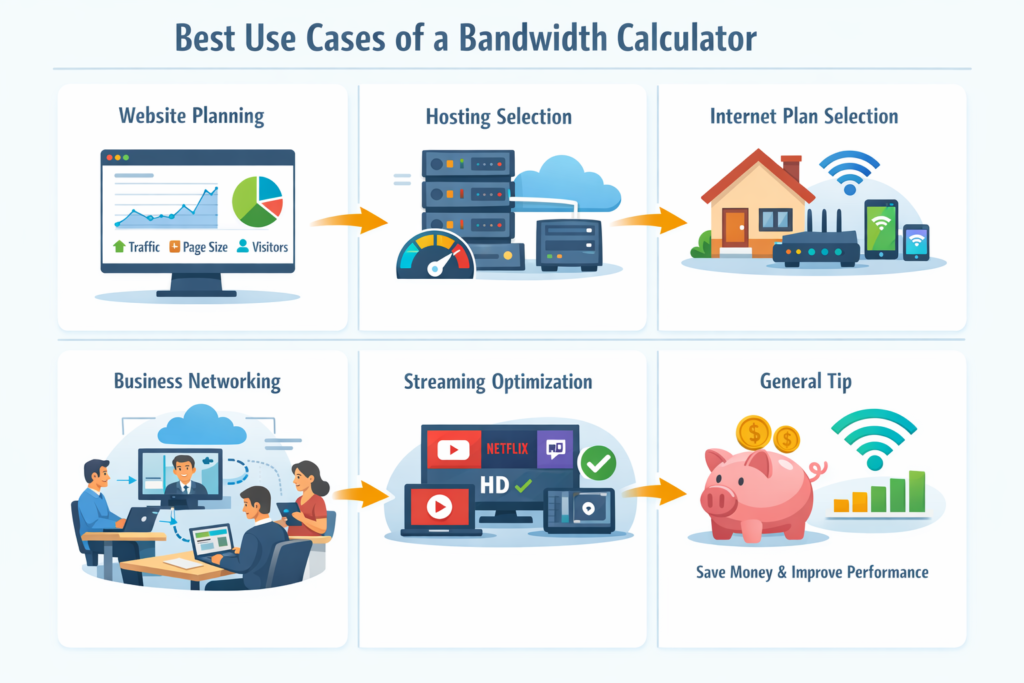
A bandwidth calculator is a versatile tool that helps both individuals and businesses optimize their internet and network usage.
Common use cases include:
- Website Planning: Estimate bandwidth requirements based on ,page speed,page size, traffic, and visitor behavior.
- Hosting Selection: Choose the right hosting plan to prevent overage charges and slow website performance.
- Internet Plan Selection: Determine the internet speed and data allowance needed for home or office use.
- Business Networking: Ensure smooth connectivity for multiple employees, cloud services, and video conferencing.
- Streaming Optimization: Plan bandwidth for streaming platforms like YouTube, Netflix, or Twitch to avoid buffering.
Tip: Using a bandwidth calculator before making decisions saves money, prevents network issues, and improves overall online performance.
Conclusion
A bandwidth calculator is an essential tool for anyone looking to optimize their internet experience. It provides a clear understanding of how much bandwidth is required for streaming, gaming, browsing, or running a business network. Using one helps prevent buffering, ensures smooth connectivity, and allows for informed decisions when choosing internet plans or upgrading network infrastructure.
By regularly monitoring your network needs and using a trusted age calculator, you can save costs, improve performance, and future-proof your internet setup. Whether for personal or business use, a bandwidth calculator makes internet management simple, precise, and stress-free.
FAQs
What is a bandwidth calculator?
A bandwidth calculator is a tool—online or software-based—that estimates the required internet or network bandwidth based on the number of devices, type of activities (streaming, gaming, browsing), and duration of use. It helps ensure smooth performance and prevents network congestion.
Who should use a bandwidth calculator?
- Home users with multiple devices
- Gamers needing low latency for online play
- Streamers watching HD or 4K content
- Businesses managing office networks or remote employees
Anyone looking to optimize internet usage and select the right internet plan can benefit from using a bandwidth calculator.
How does a bandwidth calculator work?
The calculator takes into account:
- Number of users or devices
- Type of activity (e.g., HD streaming, gaming, video conferencing)
- Duration of internet usage
- File sizes or data transfers
It then estimates the minimum required bandwidth to ensure smooth operation, often in Mbps.
What is the difference between bandwidth and internet speed?
- Bandwidth: The maximum capacity your connection can handle (data limit).
- Internet speed: The actual rate at which data is transferred.
While related, a high bandwidth doesn’t guarantee maximum speed if your network is congested or hardware is limited.
How much bandwidth do I need for streaming and gaming?
- Standard-definition video: 3–4 Mbps
- HD video: 5–8 Mbps
- 4K Ultra HD video: 15–25 Mbps
- Online gaming: 3–6 Mbps per player
It’s recommended to add 20–30% extra bandwidth if multiple devices or users are connected simultaneously.
Are online bandwidth calculators accurate?
Yes, online calculators provide reliable estimates if you input accurate information about devices, usage, and activities. However, real-world factors like Wi-Fi interference, network congestion, or device limitations may affect actual performance.
Can a bandwidth calculator help save money?
Absolutely. By knowing your exact bandwidth requirements, you can:
- Avoid paying for unnecessary high-speed plans
- Optimize network allocation across devices
- Reduce data overage charges and improve overall network efficiency