
In 2026, digital writing has become an essential part of everyday life. From students completing assignments to writers publishing blogs, developers editing code, and professionals drafting reports, the demand for fast, reliable, and secure writing tools is higher than ever. Traditional desktop software is gradually being replaced by online text editors—lightweight, browser-based tools that allow users to write instantly without downloads or installations.
An online text editor is no longer just a simple typing space. Modern tools offer cloud storage, real-time collaboration, AI-powered writing assistance, formatting options, cross-device access, and strong privacy protections. Best of all, many of these tools are free, making them accessible to anyone with an internet connection.
This in-depth guide explores everything you need to know about online text editors in 2026: what they are, how they work, their features, benefits, safety considerations, and how to choose the right one for your needs.
What Is an Online Text Editor?
An online text editor is a web-based application that allows users to create, edit, and manage text directly in a web browser, including useful features like Reverse Text, text formatting, and instant editing. Unlike traditional word processors that require installation on a computer, online text editors run entirely online and can be accessed from any device, making tasks like reversing text fast, easy, and convenient.
Simple Definition
At its core, an online text editor is a digital writing tool that works inside a browser. You open a website, start typing, and your text is saved either temporarily or securely in the cloud.
How Online Text Editors Have Evolved
Early online editors were extremely basic—mostly used for quick notes or copying text. In 2026, they have evolved into powerful platforms with features comparable to desktop software, including:
- Rich text formatting
- Auto-save and version history
- Real-time collaboration
- Markdown and code support
- AI writing tools
- Secure cloud storage
- AI Content Detector for checking originality and human-like content
Who Uses Online Text Editors?
Online text editors are widely used by:
- Students for assignments and notes
- Writers and bloggers for articles and creative work
- Journalists for fast publishing
- Developers for code snippets and documentation
- Businesses for reports and content drafts
Their simplicity and flexibility make them suitable for almost anyone who writes digitally.
How Does an Online Text Editor Work?
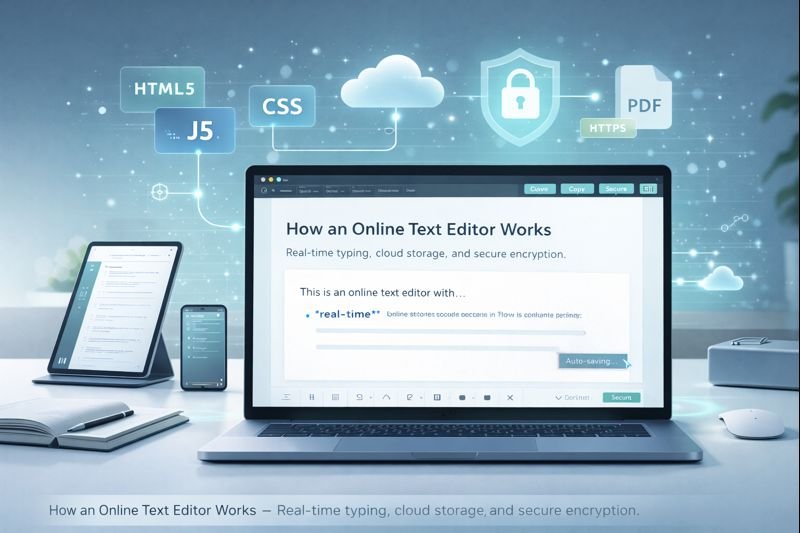
Online text editors rely on modern web technologies to provide fast, smooth, and secure writing experiences.
Browser-Based Technology
Online text editors run using technologies such as:
- HTML5
- CSS
- JavaScript
- Cloud APIs
These technologies allow editors to function like desktop applications while remaining lightweight and accessible.
Real-Time Text Processing
As you type:
- Your input is captured instantly
- Formatting or grammar checks are applied
- The editor saves changes automatically and includes PDF Editor features
This ensures a seamless writing experience with minimal risk of data loss.
Cloud Storage and Auto-Save
Most modern online text editors automatically save your work:
- After every few seconds
- When you stop typing
- When the browser closes
Cloud-based editors sync your documents across devices, allowing you to continue writing from anywhere.
Offline Capabilities
Some advanced editors support offline writing using browser caching or progressive web apps (PWAs). Your changes sync once you reconnect to the internet.
Security and Data Handling
Secure editors use:
- HTTPS encryption is Headers
- Secure servers
- Authentication systems
This protects your data from unauthorized access.
Key Features of a Modern Online Text Editor
In 2026, a high-quality online text editor is defined by its features. Below are the most important ones.
Instant Access
No downloads or installations are required. You open the editor and start writing immediately.
Clean and Distraction-Free Interface
Modern editors prioritize focus, offering:
- Minimal design
- Dark mode
- Full-screen writing mode
Rich Text Formatting
Essential formatting options include:
- Headings (H1–H6)
- Bold, italic, underline
- Bullet points and numbered lists
- Links and quotes
Auto-Save and Version History
Auto-save ensures no work is lost, while version history allows you to restore earlier drafts.
Cross-Device Compatibility
You can write on:
- Desktop computers
- Laptops
- Tablets
- Smartphones
Your work stays synced across devices.
Collaboration Tools
Many editors support:
- Real-time co-editing
- Comments and suggestions
- Sharing links with permissions
Markdown and Code Support
Developers and technical writers benefit from:
- Syntax highlighting
- Markdown preview
- Clean code formatting
AI Writing Assistance
AI tools help with:
- Grammar and spelling
- Sentence improvement
- Summarization
- Content rewriting
Export and Sharing Options
Documents can be exported as:
- TXT
- DOCX
- HTML
Why Use an Online Text Editor in 2026?
Online text editors have become the preferred writing tools for millions of users worldwide.
Accessibility Anywhere
You can write from any location using any device with internet access.
Cost-Effective
Many online text editors are completely free, while premium versions are affordable.
No System Limitations
They work across operating systems:
- Windows
- macOS
- Linux
- Android
- iOS
Ideal for Remote Work
Collaboration features make online editors perfect for remote teams and online education.
Automatic Backups
Cloud saving protects your work from accidental loss.
Lightweight and Fast
Online editors use fewer system resources than traditional software.
Comparison of Top Online Text Editors (Free vs Premium)
| Type | Advantages | Limitations | Ideal For |
| Free Editors | No cost, instant access | Basic features | Students / Casual writers |
| Premium Editors | AI tools, cloud storage, team collab | Subscription fee | Professionals / Teams |
Top 5 Online Text Editors (2026 Comparison)
| Editor | Features | Free Plan | Security | Ideal For |
| Google Docs | Real-time collab, cloud | ✔️ | High | Students & Teams |
| StackEdit | Markdown support | ✔️ | High | Developers |
| Grammarly Editor | AI assistance | ⚙️ Limited | High | Writers |
| Notepad Online | Simple, fast | ✔️ | Medium | Quick Notes |
| Quill | Privacy-first | ✔️ | High | Professionals |
How to Choose the Best Online Text Editor
- Define Purpose — blogs, essays, code, or team work?
- Ease of Use — minimal learning curve
- Performance & Reliability — fast loading, autosave
- Security & Privacy — HTTPS, no data tracking
- Export Options — check file format support
- Budget — free vs premium
How to Choose the Best Online Text Editor for Your Needs
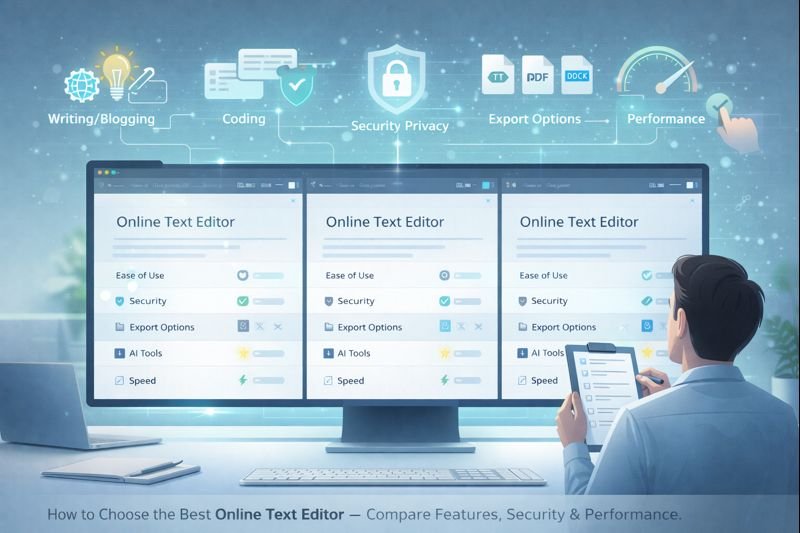
Not all editors are the same. Here’s how to choose the right one.
1. Define Your Purpose
Ask yourself:
- Are you writing essays, blogs, or code?
- Do you need collaboration?
- Is formatting important?
2. Ease of Use
A good editor should be intuitive and easy to learn.
3. Performance and Reliability
Look for fast loading, smooth typing, and minimal downtime.
4. Security and Privacy
Choose tools that offer:
- Encryption
- Password protection
- Data control
5. Export Options
Ensure compatibility with the formats you need.
6. Budget Considerations
Avoid paying for features you don’t use.
Online Text Editor for Students, Writers, and Developers
Different users have different needs.
For Students
Online text editors help students:
- Write assignments
- Take notes
- Collaborate on group projects
- Submit work easily
For Writers and Bloggers
Writers benefit from:
- Distraction-free writing
- Draft management
- Formatting tools
- Word count tracking
For Developers
Developers prefer editors with:
- Syntax highlighting
- Markdown support
- Code formatting
- Documentation tools
Safety & Privacy in Online Writing Tools
Security is a major concern in online writing.
1. Data Encryption
Secure editors protect data during transfer and storage.
2. User Control
Users should be able to:
- Set document privacy
- Control sharing permissions
- Delete data permanently
3. No Unnecessary Tracking
Privacy-focused editors avoid collecting unnecessary user data.
4. Local-Only Editors
Some tools don’t store data on servers at all, offering maximum privacy.
5. Best Practices for Users
- Use strong passwords
- Avoid public networks for sensitive work
- Log out on shared devices
Conclusion
Online text editors have become an essential writing solution in 2026. They offer instant access, cloud storage, collaboration tools, and strong security—all without the need for installation. Whether you are a student working on assignments, a writer creating content, or a developer editing documentation, an online text editor provides a fast, reliable, and efficient writing environment.
With features like auto-save, cross-device access, AI writing assistance, and plagiarism checks, online text editors are shaping the future of digital writing. Choosing the right tool can significantly boost productivity, improve content quality, and ensure your work remains safe and accessible anytime, anywhere.
FAQs
What is an online text editor?
An online text editor is a browser-based writing tool that allows users to create, edit, and format text without installing any software. It works directly on the internet and is accessible from any device.
Is an online text editor free to use?
Yes, many online text editors are completely free. Some also offer premium versions with advanced features such as AI writing tools, extra storage, and enhanced security.
Are online text editors safe and secure?
Reputable online text editors use HTTPS encryption, secure cloud servers, and privacy controls to protect user data. Always choose tools with clear privacy policies.
Do online text editors automatically save my work?
Most modern online text editors include auto-save functionality, ensuring your content is saved in real time and protected from accidental data loss.
Can I use an online text editor without creating an account?
Yes, many tools allow instant writing without registration. However, creating an account may be required for cloud storage and collaboration features.
Can I use an online text editor offline?
Some advanced online text editors support offline mode using browser caching or progressive web apps. Basic editors usually require an internet connection.
Are online text editors better than desktop software?
Online text editors are more flexible, accessible, and collaboration-friendly. Desktop software may still be preferred for heavy offline work, but online tools are ideal for modern workflows.